Exercise 1 Find the Probability That One Review Will Take Her 35 to 425 Hours Answers
In previous math courses, yous've no doubt see the infamous "discussion issues." Unfortunately, these bug rarely resemble the type of problems we really see in everyday life. In math books, y'all usually are told exactly which formula or procedure to employ, and are given exactly the data you need to answer the question. In existent life, trouble solving requires identifying an advisable formula or procedure, and determining what data y'all will demand (and won't need) to answer the question.
In this affiliate, we will review several basic but powerful algebraic ideas: percents, rates, and proportions. We volition so focus on the problem solving process, and explore how to apply these ideas to solve issues where nosotros don't take perfect information.
Percents
In the 2004 vice-presidential debates, Edwards's claimed that US forces take suffered "90% of the coalition casualties" in Republic of iraq. Cheney disputed this, saying that in fact Iraqi security forces and coalition allies "have taken almost 50 percent" of the casualties.[i] Who is correct? How can we brand sense of these numbers?
Pct literally means "per 100," or "parts per hundred." When nosotros write 40%, this is equivalent to the fraction [latex]\displaystyle\frac{twoscore}{100}\\[/latex] or the decimal 0.40. Notice that 80 out of 200 and ten out of 25 are also 40%, since [latex]\displaystyle\frac{80}{200}=\frac{10}{25}=\frac{forty}{100}\\[/latex].
Instance ane
243 people out of 400 country that they similar dogs. What percentage is this?
Solution
[latex]\displaystyle\frac{243}{400}=0.6075=\frac{60.75}{100}\\[/latex]. This is 60.75%.
Notice that the per centum can be found from the equivalent decimal by moving the decimal point ii places to the right.
Example 2
Write each every bit a pct:
- [latex]\displaystyle\frac{1}{4}\\[/latex]
- 0.02
- 2.35
Solutions
- [latex]\displaystyle\frac{1}{4}=0.25\\[/latex] = 25%
- 0.02 = 2%
- 2.35 = 235%
Percents
If nosotros take a part that is some percent of a whole, and then [latex]\displaystyle\text{percent}=\frac{\text{office}}{\text{whole}}\\[/latex], or equivalently,[latex]\text{office}\cdot\text{whole}=\text{percent}\\[/latex].
To do the calculations, nosotros write the percent as a decimal.
Example 3
The sales tax in a boondocks is 9.4%. How much taxation volition you pay on a $140 purchase?
Solution
Hither, $140 is the whole, and we desire to find 9.4% of $140. We start by writing the per centum as a decimal by moving the decimal point two places to the left (which is equivalent to dividing by 100). We can then compute: tax = 0.094(140) = $xiii.16 in revenue enhancement.
Example 4
In the news, you lot hear "tuition is expected to increase by 7% next year." If tuition this year was $1200 per quarter, what will it be next year?
Solution
The tuition side by side year will be the current tuition plus an additional 7%, so it will exist 107% of this year'southward tuition: $1200(1.07) = $1284.
Alternatively, we could have offset calculated 7% of $1200: $1200(0.07) = $84.
Notice this is not the expected tuition for adjacent twelvemonth (nosotros could just wish). Instead, this is the expected increase, and then to calculate the expected tuition, we'll demand to add this change to the previous year's tuition: $1200 + $84 = $1284.
Try Information technology Now
A Goggle box originally priced at $799 is on sale for 30% off. There is then a 9.2% sales revenue enhancement. Notice the price after including the discount and sales tax.
Case v
The value of a car dropped from $7400 to $6800 over the last yr. What percent decrease is this?
Solution
To compute the percent change, we first need to find the dollar value change: $6800 – $7400 = –$600. Often we will have the accented value of this corporeality, which is called the accented change: |–600| = 600.
Since we are calculating the decrease relative to the starting value, nosotros compute this pct out of $7400:
[latex]\displaystyle\frac{600}{7400}=0.081=[/latex] 8.i% decrease. This is chosen a relative change.
Accented and Relative Modify
Given two quantities,
Absolute change =[latex]\displaystyle|\text{ending quantity}-\text{starting quantity}|[/latex]
Relative alter: [latex]\displaystyle\frac{\text{absolute change}}{\text{starting quantity}}[/latex]
Absolute change has the aforementioned units every bit the original quantity.
Relative change gives a per centum alter.
The starting quantity is called the base of operations of the percent change.
The base of operations of a percent is very important. For example, while Nixon was president, it was argued that marijuana was a "gateway" drug, claiming that 80% of marijuana smokers went on to use harder drugs like cocaine. The problem is, this isn't truthful. The true claim is that 80% of harder drug users first smoked marijuana. The difference is one of base: 80% of marijuana smokers using difficult drugs, vs. 80% of hard drug users having smoked marijuana. These numbers are non equivalent. As it turns out, only i in two,400 marijuana users actually get on to use harder drugs.[ii]
Example half dozen
There are about 75 QFC supermarkets in the United states of america. Albertsons has about 215 stores. Compare the size of the 2 companies.
Solution
When nosotros make comparisons, we must ask first whether an absolute or relative comparing. The absolute difference is 215 – 75 = 140. From this, nosotros could say "Albertsons has 140 more than stores than QFC." Even so, if you lot wrote this in an article or paper, that number does not hateful much. The relative deviation may be more meaningful. There are ii different relative changes we could calculate, depending on which store we apply as the base of operations:
Using QFC as the base of operations, [latex]\displaystyle\frac{140}{75}=ane.867\\[/latex].
This tells u.s.a. Albertsons is 186.7% larger than QFC.
Using Albertsons every bit the base,[latex]\displaystyle\frac{140}{215}=0.651\\[/latex].
This tells us QFC is 65.1% smaller than Albertsons.
Notice both of these are showing per centum differences. We could also calculate the size of Albertsons relative to QFC:[latex]\displaystyle\frac{215}{75}=2.867\\[/latex], which tells u.s. Albertsons is 2.867 times the size of QFC. Likewise, nosotros could calculate the size of QFC relative to Albertsons:[latex]\displaystyle\frac{75}{215}=0.349\\[/latex], which tells us that QFC is 34.ix% of the size of Albertsons.
Example 7
Suppose a stock drops in value by threescore% one week, then increases in value the next week past 75%. Is the value higher or lower than where it started?
Solution
To answer this question, suppose the value started at $100. After one calendar week, the value dropped by lx%: $100 – $100(0.threescore) = $100 – $60 = $40.
In the side by side week, observe that base of the percent has changed to the new value, $forty. Computing the 75% increment: $40 + $xl(0.75) = $40 + $30 = $70.
In the end, the stock is still $xxx lower, or [latex]\displaystyle\frac{\$30}{100}[/latex] = 30% lower, valued than it started.
Try Information technology Now
The Us federal debt at the end of 2001 was $5.77 trillion, and grew to $6.20 trillion by the end of 2002. At the end of 2005 it was $7.91 trillion, and grew to $8.45 trillion by the end of 2006.[3] Calculate the accented and relative increase for 2001–2002 and 2005–2006. Which year saw a larger increment in federal debt?
Example 8
A Seattle Times article on high schoolhouse graduation rates reported "The number of schools graduating 60 percent or fewer students in four years—sometimes referred to equally "dropout factories"—decreased by 17 during that time menstruation. The number of kids attention schools with such low graduation rates was cut in half."
- Is the "subtract by 17" number a useful comparison?
- Considering the terminal judgement, can we conclude that the number of "dropout factories" was originally 34?
Solution
- This number is difficult to evaluate, since we accept no ground for judging whether this is a larger or small change. If the number of "dropout factories" dropped from twenty to 3, that'd be a very significant alter, but if the number dropped from 217 to 200, that'd be less of an improvement.
- The concluding judgement provides relative change, which helps put the showtime judgement in perspective. We tin can estimate that the number of "dropout factories" was probably previously around 34. Nonetheless, information technology'due south possible that students just moved schools rather than the school improving, and then that estimate might not be fully accurate.
Example 9
In the 2004 vice-presidential debates, Edwards'southward claimed that US forces have suffered "90% of the coalition casualties" in Iraq. Cheney disputed this, saying that in fact Iraqi security forces and coalition allies "have taken almost 50 percentage" of the casualties. Who is correct?
Solution
Without more than information, it is difficult for u.s.a. to gauge who is correct, but nosotros can easily conclude that these two percents are talking about unlike things, then one does not necessarily contradict the other. Edward's claim was a percent with coalition forces as the base of the percent, while Cheney's merits was a percent with both coalition and Iraqi security forces as the base of the per centum. It turns out both statistics are in fact fairly authentic.
Endeavour It Now
In the 2012 presidential elections, 1 candidate argued that "the president's plan will cut $716 billion from Medicare, leading to fewer services for seniors," while the other candidate rebuts that "our plan does not cut electric current spending and actually expands benefits for seniors, while implementing cost saving measures." Are these claims in conflict, in agreement, or not comparable because they're talking nigh dissimilar things?
We'll wrap upwardly our review of percents with a couple cautions. First, when talking about a change of quantities that are already measured in percents, we accept to be careful in how nosotros describe the change.
Example ten
A politico'southward support increases from forty% of voters to 50% of voters. Describe the change.
Solution
We could depict this using an absolute modify: [latex]|fifty\%-twoscore\%|=x\%[/latex]. Find that since the original quantities were percents, this change besides has the units of percent. In this example, it is best to draw this as an increment of 10 pct points.
In contrast, we could compute the percent change:[latex]\displaystyle\frac{10\%}{xl\%}=0.25=25\%[/latex] increase. This is the relative modify, and we'd say the political leader's support has increased by 25%.
Lastly, a caution confronting averaging percents.
Example xi
A basketball thespian scores on twoscore% of 2-point field goal attempts, and on xxx% of 3-bespeak of field goal attempts. Find the actor'south overall field goal percentage.
Solution
It is very tempting to average these values, and claim the overall boilerplate is 35%, just this is likely not correct, since most players make many more 2-betoken attempts than 3-point attempts. Nosotros don't actually have enough information to answer the question. Suppose the player attempted 200 2-point field goals and 100 3-indicate field goals. Then they made 200(0.forty) = 80 2-point shots and 100(0.30) = xxx 3-point shots. Overall, they made 110 shots out of 300, for a [latex]\displaystyle\frac{110}{300}=0.367=36.7\%\\[/latex] overall field goal percent.
Proportions and Rates
If you lot wanted to power the city of Seattle using current of air power, how many windmills would you need to install? Questions like these can be answered using rates and proportions.
Rates
A rate is the ratio (fraction) of 2 quantities.
A unit rate is a rate with a denominator of 1.
Instance 12
Your motorcar can drive 300 miles on a tank of xv gallons. Express this as a rate.
Solution
Expressed as a charge per unit, [latex]\displaystyle\frac{300\text{ miles}}{15\text{ gallons}}\\[/latex]. We can carve up to detect a unit of measurement rate:[latex]\displaystyle\frac{xx\text{ miles}}{1\text{ gallon}}\\[/latex], which we could as well write as[latex]\displaystyle{twenty}\frac{\text{miles}}{\text{gallon}}\\[/latex], or just 20 miles per gallon.
Proportion Equation
A proportion equation is an equation showing the equivalence of two rates or ratios.
Case 13
Solve the proportion [latex]\displaystyle\frac{5}{3}=\frac{x}{6}\\[/latex] for the unknown value ten.
Solution
This proportion is request united states to detect a fraction with denominator 6 that is equivalent to the fraction[latex]\displaystyle\frac{5}{3}\\[/latex]. We tin can solve this past multiplying both sides of the equation by half-dozen, giving [latex]\displaystyle{x}=\frac{5}{3}\cdot6=10\\[/latex].
Example fourteen
A map scale indicates that ½ inch on the map corresponds with iii existent miles. How many miles apart are two cities that are [latex]\displaystyle{ii}\frac{i}{4}\\[/latex] inches autonomously on the map?
Solution
We can fix up a proportion by setting equal two [latex]\displaystyle\frac{\text{map inches}}{\text{real miles}}\\[/latex] rates, and introducing a variable, x, to stand for the unknown quantity—the mile distance between the cities.
| [latex]\displaystyle\frac{\frac{i}{two}\text{map inch}}{3\text{ miles}}=\frac{2\frac{ane}{4}\text{map inches}}{x\text{ miles}}\\[/latex] | Multiply both sides by tenand rewriting the mixed number |
| [latex]\displaystyle\frac{\frac{ane}{2}}{iii}\cdot{ten}=\frac{9}{4}\\[/latex] | Multiply both sides by three |
| [latex]\displaystyle\frac{1}{ii}ten=\frac{27}{iv}\\[/latex] | Multiply both sides by 2 (or carve up by ½) |
| [latex]\displaystyle{ten}=\frac{27}{2}=13\frac{1}{2}\text{ miles}\\[/latex] |
Many proportion problems can as well be solved using dimensional analysis, the process of multiplying a quantity by rates to change the units.
Instance 15
Your machine can bulldoze 300 miles on a tank of xv gallons. How far tin can it bulldoze on forty gallons?
Solution
We could certainly reply this question using a proportion: [latex]\displaystyle\frac{300\text{ miles}}{fifteen\text{ gallons}}=\frac{10\text{ miles}}{40\text{ gallons}}\\[/latex].
However, we earlier establish that 300 miles on 15 gallons gives a rate of 20 miles per gallon. If we multiply the given 40 gallon quantity past this rate, the gallons unit "cancels" and we're left with a number of miles:
[latex]\displaystyle40\text{ gallons}\cdot\frac{twenty\text{ miles}}{\text{gallon}}=\frac{twoscore\text{ gallons}}{1}\cdot\frac{xx\text{ miles}}{\text{gallons}}=800\text{ miles}\\[/latex]
Observe if instead we were asked "how many gallons are needed to bulldoze 50 miles?" we could answer this question past inverting the twenty mile per gallon rate so that the miles unit cancels and we're left with gallons:
[latex]\displaystyle{50}\text{ miles}\cdot\frac{1\text{ gallon}}{twenty\text{ miles}}=\frac{l\text{ miles}}{i}\cdot\frac{1\text{ gallon}}{20\text{ miles}}=\frac{50\text{ gallons}}{xx}=ii.5\text{ gallons}\\[/latex]
Dimensional analysis can also exist used to do unit of measurement conversions. Here are some unit of measurement conversions for reference.
Unit Conversions
Length
| 1 foot (ft) = 12 inches (in) | 1 yard (yd) = 3 feet (ft) |
| 1 mile = 5,280 feet | |
| chiliad millimeters (mm) = 1 meter (m) | 100 centimeters (cm) = 1 meter |
| 1000 meters (m) = 1 kilometer (km) | ii.54 centimeters (cm) = one inch |
Weight and Mass
| i pound (lb) = 16 ounces (oz) | 1 ton = 2000 pounds |
| one thousand milligrams (mg) = 1 gram (g) | 1000 grams = 1kilogram (kg) |
| 1 kilogram = two.2 pounds (on globe) |
Capacity
| i cup = 8 fluid ounces (fl oz)[4] | ane pint = 2 cups |
| 1 quart = two pints = four cups | ane gallon = iv quarts = 16 cups |
| 1000 milliliters (ml) = one liter (L) |
Example xvi
A bicycle is traveling at xv miles per hour. How many feet will it cover in 20 seconds?
Solution
To answer this question, nosotros demand to catechumen 20 seconds into feet. If we know the speed of the wheel in anxiety per 2nd, this question would be simpler. Since we don't, we will demand to do boosted unit conversions. We will need to know that 5280 ft = 1 mile. We might get-go by converting the 20 seconds into hours:
[latex]\displaystyle{20}\text{ seconds}\cdot\frac{ane\text{ minute}}{60\text{ seconds}}\cdot\frac{ane\text{ hour}}{threescore\text{ minutes}}=\frac{ane}{180}\text{ hour}\\[/latex]
Now we can multiply past the 15 miles/60 minutes
[latex]\displaystyle\frac{i}{180}\text{ 60 minutes}\cdot\frac{fifteen\text{ miles}}{1\text{ hour}}=\frac{1}{12}\text{ mile}\\[/latex]
Now nosotros can convert to feet
[latex]\displaystyle\frac{one}{12}\text{ mile}\cdot\frac{5280\text{ anxiety}}{i\text{ mile}}=440\text{ feet}\\[/latex]
Nosotros could accept also done this entire calculation in 1 long set of products:
[latex]\displaystyle20\text{ seconds}\cdot\frac{1\text{ minute}}{60\text{ seconds}}\cdot\frac{i\text{ hour}}{lx\text{ minutes}}=\frac{fifteen\text{ miles}}{1\text{ miles}}=\frac{5280\text{ feet}}{1\text{ mile}}=\frac{one}{180}\text{ hour}\\[/latex]
Endeavor It At present
A 1000 foot spool of bare 12-estimate copper wire weighs 19.8 pounds. How much will xviii inches of the wire counterbalance, in ounces?
Notice that with the miles per gallon example, if we double the miles driven, we double the gas used. Besides, with the map altitude case, if the map distance doubles, the real-life distance doubles. This is a key feature of proportional relationships, and one we must ostend before assuming 2 things are related proportionally.
Example 17
Suppose y'all're tiling the floor of a 10 ft by x ft room, and find that 100 tiles will exist needed. How many tiles will be needed to tile the floor of a twenty ft past 20 ft room?
Solution
In this case, while the width the room has doubled, the area has quadrupled. Since the number of tiles needed corresponds with the expanse of the floor, non the width, 400 tiles will be needed. We could find this using a proportion based on the areas of the rooms:
[latex]\displaystyle\frac{100\text{ tiles}}{100\text{ft}^2}=\frac{n\text{ tiles}}{400\text{ft}^2}\\[/latex]
Other quantities just don't scale proportionally at all.
Example 18
Suppose a minor visitor spends $1000 on an advertising campaign, and gains 100 new customers from information technology. How many new customers should they expect if they spend $x,000?
Solution
While it is tempting to say that they will gain 1000 new customers, it is likely that boosted advertisement volition be less effective than the initial advertisement. For instance, if the visitor is a hot tub store, at that place are likely merely a fixed number of people interested in buying a hot tub, so there might non fifty-fifty be 1000 people in the boondocks who would be potential customers.
Sometimes when working with rates, proportions, and percents, the process tin can exist fabricated more challenging by the magnitude of the numbers involved. Sometimes, large numbers are simply difficult to cover.
Example 19
Compare the 2010 U.Due south. war machine budget of $683.7 billion to other quantities.
Solution
Here nosotros have a very large number, about $683,700,000,000 written out. Of class, imagining a billion dollars is very hard, and then information technology tin help to compare it to other quantities.
If that amount of coin was used to pay the salaries of the ane.4 million Walmart employees in the U.S., each would earn over $488,000.
There are about 300 million people in the U.S. The military budget is virtually $2,200 per person.
If you were to put $683.seven billion in $100 bills, and count out one per second, it would take 216 years to cease counting it.
Example 20
Compare the electricity consumption per capita in Communist china to the rate in Japan.
Solution
To address this question, we will first need data. From the CIA[5] website we can find the electricity consumption in 2011 for Communist china was 4,693,000,000,000 KWH (kilowatt-hours), or 4.693 trillion KWH, while the consumption for Japan was 859,700,000,000, or 859.vii billion KWH. To find the rate per capita (per person), we will also need the population of the 2 countries. From the World Bank,[6] we can find the population of Communist china is one,344,130,000, or 1.344 billion, and the population of Japan is 127,817,277, or 127.eight million.
Calculating the consumption per capita for each country:
China: [latex]\displaystyle\frac{iv,693,000,000,000\text{KWH}}{1,344,130,000\text{ people}}\\[/latex] ≈ 3491.5 KWH per person
Nippon: [latex]\displaystyle\frac{859,700,000,000\text{KWH}}{127,817,277\text{ people}}\\[/latex] ≈ 6726 KWH per person
While China uses more five times the electricity of Japan overall, considering the population of Nippon is so much smaller, information technology turns out Japan uses near twice the electricity per person compared to China.
Geometry
Geometric shapes, too equally surface area and volumes, can often be important in problem solving.
Example 21
You lot are curious how tall a tree is, but don't take any way to climb it. Depict a method for determining the top.
Solution
In that location are several approaches nosotros could accept. Nosotros'll employ one based on triangles, which requires that it'due south a sunny mean solar day. Suppose the tree is casting a shadow, say 15 ft long. I tin and then accept a friend help me measure out my own shadow. Suppose I am 6 ft alpine, and cast a one.5 ft shadow. Since the triangle formed past the tree and its shadow has the aforementioned angles every bit the triangle formed by me and my shadow, these triangles are chosen like triangles and their sides will calibration proportionally. In other words, the ratio of meridian to width volition exist the same in both triangles. Using this, we can detect the height of the tree, which we'll announce by h:
[latex]\displaystyle\frac{6\text{ft tall}}{1.5\text{ft shadow}}=\frac{h\text{ft tall}}{15\text{ft shadow}}\\[/latex]
Multiplying both sides by 15, we get h = 60. The tree is about 60 ft tall.
It may be helpful to call up some formulas for areas and volumes of a few basic shapes.
Areas
Rectangle
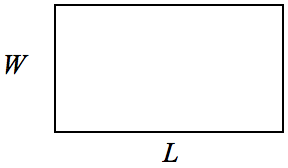
Area: L · W
Perimeter: 2L + 2W
Circle
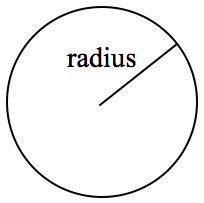
Radius:r
Area: πr 2
Circumference: 2πr
Volumes
Rectangular Box
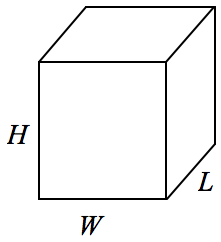
Volume: L·W·H
Cylinder
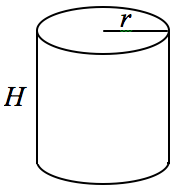
Book: πr 2 H
Example 22
If a 12 inch bore pizza requires 10 ounces of dough, how much dough is needed for a sixteen inch pizza?
Solution
To answer this question, we need to consider how the weight of the dough will calibration. The weight will be based on the book of the dough. However, since both pizzas will be nearly the same thickness, the weight will scale with the area of the acme of the pizza. We can find the area of each pizza using the formula for area of a circumvolve, [latex]A=\pi{r}^2\\[/latex]:
A 12″ pizza has radius 6 inches, and so the area will be [latex]\pi6^2\\[/latex] = about 113 square inches.
A xvi″ pizza has radius viii inches, so the area will be [latex]\pi8^2\\[/latex] = about 201 square inches.
Observe that if both pizzas were 1 inch thick, the volumes would be 113 inthree and 201 inthree respectively, which are at the same ratio as the areas. As mentioned before, since the thickness is the same for both pizzas, we tin safely ignore information technology.
We can now prepare a proportion to find the weight of the dough for a 16″ pizza:
[latex]\displaystyle\frac{10\text{ ounces}}{113\text{in}^ii}=\frac{x\text{ ounces}}{201\text{in}^ii}\\[/latex]
Multiply both sides by 201
[latex]\displaystyle{x}=201\cdot\frac{ten}{113}\\[/latex] = about 17.8 ounces of dough for a sixteen″ pizza.
Information technology is interesting to note that while the diameter is [latex]\displaystyle\frac{16}{12}\\[/latex] = 1.33 times larger, the dough required, which scales with area, is ane.33two = i.78 times larger.
Example 23
A company makes regular and jumbo marshmallows. The regular marshmallow has 25 calories. How many calories will the jumbo marshmallow have?
Solution
We would expect the calories to scale with volume. Since the marshmallows take cylindrical shapes, we tin use that formula to find the volume. From the grid in the image, we can estimate the radius and height of each marshmallow.
The regular marshmallow appears to have a diameter of about three.5 units, giving a radius of 1.75 units, and a pinnacle of about iii.five units. The volume is nearly π(1.75)2(3.5) = 33.7 units3.
The colossal marshmallow appears to take a diameter of about 5.5 units, giving a radius of 2.75 units, and a height of most 5 units. The book is nearly π(two.75)2(5) = 118.8 unitsthree.
We could now set up a proportion, or use rates. The regular marshmallow has 25 calories for 33.vii cubic units of book. The jumbo marshmallow will have:
[latex]\displaystyle{118.8}\text{ units}^iii\cdot\frac{25\text{ calories}}{33.7\text{ units}^iii}=88.ane\text{ calories}\\[/latex]
It is interesting to note that while the diameter and elevation are about 1.five times larger for the jumbo marshmallow, the volume and calories are most 1.53 = 3.375 times larger.
Try It Now
A website says that yous'll need 48 50-pound bags of sand to fill a sandbox that measure 8ft past 8ft by 1ft. How many numberless would you lot need for a sandbox 6ft past 4ft past 1ft?
Problem Solving and Estimating
Finally, we will bring together the mathematical tools nosotros've reviewed, and employ them to arroyo more complex problems. In many bug, it is tempting to take the given information, plug it into whatever formulas you have handy, and promise that the result is what you were supposed to find. Chances are, this approach has served you well in other math classes.
This arroyo does not piece of work well with real life problems. Instead, problem solving is best approached past start starting at the end: identifying exactly what you lot are looking for. From there, you then work backwards, asking "what information and procedures will I need to discover this?" Very few interesting questions can exist answered in ane mathematical step; frequently times y'all will need to chain together a solution pathway, a series of steps that will allow you to answer the question.
Problem Solving Procedure
- Identify the question you're trying to answer.
- Work backwards, identifying the information you will need and the relationships you will utilise to reply that question.
- Keep working backwards, creating a solution pathway.
- If you lot are missing necessary information, look it upward or estimate it. If you accept unnecessary information, ignore it.
- Solve the problem, post-obit your solution pathway.
In most problems we piece of work, we will be approximating a solution, because we will not have perfect information. Nosotros volition begin with a few examples where we will be able to approximate the solution using bones knowledge from our lives.
Example 24
How many times does your middle beat out in a year?
Solution
This question is asking for the charge per unit of heart beats per year. Since a year is a long time to measure middle beats for, if we knew the rate of heart beats per infinitesimal, we could scale that quantity up to a year. And then the data we need to reply this question is heart beats per infinitesimal. This is something you lot tin easily measure by counting your pulse while watching a clock for a minute.
Suppose you count 80 beats in a minute. To convert this beats per year:
[latex]\displaystyle\frac{80\text{ beats}}{1\text{ minute}}\cdot\frac{60\text{ minutes}}{1\text{ 60 minutes}}\cdot\frac{24\text{ hours}}{1\text{ day}}\cdot\frac{365\text{ days}}{one\text{ year}}=42,048,000\text{ beats per twelvemonth}\\[/latex]
Case 25
How thick is a single sheet of paper? How much does it weigh?
Solution
While you might have a sheet of paper handy, trying to measure it would be catchy. Instead we might imagine a stack of newspaper, and so scale the thickness and weight to a single sheet. If you lot've e'er bought newspaper for a printer or copier, you probably bought a ream, which contains 500 sheets. We could estimate that a ream of paper is about 2 inches thick and weighs about 5 pounds. Scaling these down,
[latex]\displaystyle\frac{2\text{ inches}}{\text{ream}}\cdot\frac{1\text{ ream}}{500\text{ pages}}=0.004\text{ inches per canvass}\\[/latex]
[latex]\displaystyle\frac{v\text{ pounds}}{\text{ream}}\cdot\frac{1\text{ ream}}{500\text{ pages}}=0.01\text{ pounds per canvass, or }=0.16\text{ ounces per sheet.}\\[/latex]
Example 26
A recipe for zucchini muffins states that it yields 12 muffins, with 250 calories per muffin. Yous instead decide to make mini-muffins, and the recipe yields 20 muffins. If you lot eat iv, how many calories will y'all eat?
Solution
At that place are several possible solution pathways to respond this question. We will explore ane.
To answer the question of how many calories 4 mini-muffins volition contain, nosotros would want to know the number of calories in each mini-muffin. To find the calories in each mini-muffin, we could commencement find the full calories for the entire recipe, and so separate it past the number of mini-muffins produced. To find the full calories for the recipe, we could multiply the calories per standard muffin by the number per muffin. Notice that this produces a multi-footstep solution pathway. It is often easier to solve a trouble in small steps, rather than trying to notice a way to jump straight from the given information to the solution.
We tin now execute our plan:
[latex]\displaystyle{12}\text{ muffins}\cdot\frac{250\text{ calories}}{\text{muffin}}=3000\text{ calories for the whole recipe}\\[/latex]
[latex]\displaystyle\frac{3000\text{ calories}}{xx\text{ mini-muffins}}=\text{ gives }150\text{ calories per mini-muffin}\\[/latex]
[latex]\displaystyle4\text{ mini-muffins}\cdot\frac{150\text{ calories}}{\text{mini-muffin}}=\text{totals }600\text{ calories consumed.}\\[/latex]
Example 27
Y'all need to replace the boards on your deck. About how much will the materials cost?
Solution
At that place are two approaches we could take to this problem: one) estimate the number of boards nosotros will need and find the price per board, or 2) guess the area of the deck and find the guess cost per square human foot for deck boards. We will have the latter approach.
For this solution pathway, we will be able to reply the question if we know the cost per square foot for decking boards and the square footage of the deck. To find the cost per square pes for decking boards, we could compute the area of a single lath, and divide information technology into the price for that board. We can compute the square footage of the deck using geometric formulas. And then first we need information: the dimensions of the deck, and the price and dimensions of a unmarried deck board.
Suppose that measuring the deck, it is rectangular, measuring 16 ft by 24 ft, for a total area of 384 ftii.
From a visit to the local home shop, you find that an 8 human foot by 4 inch cedar deck board costs most $7.50. The area of this lath, doing the necessary conversion from inches to feet, is:
[latex]\displaystyle{viii}\text{ feet}\cdot4\text{ inches}\cdot\frac{ane\text{ foot}}{12\text{ inches}}=two.667\text{ft}^two{.}\\[/latex] The cost per foursquare pes is then [latex]\displaystyle\frac{\$7.50}{2.667\text{ft}^2}=\$two.8125\text{ per ft}^ii{.}\\[/latex]
This will permit us to estimate the cloth cost for the whole 384 ft2 deck
[latex]\displaystyle\$384\text{ft}^2\cdot\frac{\$2.8125}{\text{ft}^ii}=\$1080\text{ total toll.}\\[/latex]
Of grade, this cost estimate assumes that there is no waste, which is rarely the case. Information technology is mutual to add together at least x% to the cost estimate to account for waste.
Example 28
Is it worth buying a Hyundai Sonata hybrid instead the regular Hyundai Sonata?
Solution
To make this conclusion, we must get-go make up one's mind what our basis for comparison will be. For the purposes of this example, we'll focus on fuel and buy costs, but environmental impacts and maintenance costs are other factors a heir-apparent might consider.
Information technology might be interesting to compare the cost of gas to run both cars for a twelvemonth. To determine this, nosotros will need to know the miles per gallon both cars get, too equally the number of miles we expect to bulldoze in a twelvemonth. From that information, nosotros can find the number of gallons required from a year. Using the cost of gas per gallon, we can observe the running cost.
From Hyundai's website, the 2013 Sonata volition go 24 miles per gallon (mpg) in the city, and 35 mpg on the highway. The hybrid volition get 35 mpg in the city, and 40 mpg on the highway.
An average commuter drives about 12,000 miles a year. Suppose that you await to drive near 75% of that in the city, so 9,000 city miles a year, and 3,000 highway miles a twelvemonth.
We can then notice the number of gallons each auto would crave for the twelvemonth.
Sonata: [latex]\displaystyle{9000}\text{ city miles}\cdot\frac{1\text{ gallon}}{24\text{ urban center miles}}+3000\text{ highway miles}\cdot\frac{1\text{ gallon}}{35\text{ highway miles}}=460.7\text{ gallons}[/latex]
Hybrid: [latex]\displaystyle{9000}\text{ metropolis miles}\cdot\frac{ane\text{ gallon}}{35\text{ city miles}}+3000\text{ highway miles}\cdot\frac{1\text{ gallon}}{40\text{ highway miles}}=332.ane\text{ gallons}[/latex]
If gas in your surface area averages well-nigh $iii.50 per gallon, nosotros can use that to find the running toll:
Sonata: [latex]\displaystyle{460.7}\text{ gallons}\cdot\frac{\$3.l}{\text{gallon}}=\$1612.45\\[/latex]
Hybrid: [latex]\displaystyle{332.1}\text{ gallons}\cdot\frac{\$iii.fifty}{\text{gallon}}=\$1162.35\\[/latex]
The hybrid will relieve $450.x a year. The gas costs for the hybrid are about [latex]\displaystyle\frac{\$450.10}{\$1612.45}\\[/latex] = 0.279 = 27.9% lower than the costs for the standard Sonata.
While both the absolute and relative comparisons are useful hither, they still brand it hard to answer the original question, since "is information technology worth it" implies there is some tradeoff for the gas savings. Indeed, the hybrid Sonata costs about $25,850, compared to the base model for the regular Sonata, at $20,895.
To ameliorate respond the "is it worth it" question, we might explore how long it will accept the gas savings to brand upwardly for the additional initial cost. The hybrid costs $4965 more. With gas savings of $451.ten a year, information technology will accept about eleven years for the gas savings to make up for the higher initial costs.
We can conclude that if you lot wait to own the car 11 years, the hybrid is indeed worth it. If y'all plan to own the car for less than 11 years, it may still be worth it, since the resale value of the hybrid may be college, or for other non-monetary reasons. This is a case where math tin help guide your decision, just information technology tin't make it for you.
Try Information technology Now
If traveling from Seattle, WA to Spokane WA for a three-day conference, does it make more sense to drive or wing?
Source: https://courses.lumenlearning.com/atd-austincc-mathlibarts/chapter/problem-solving/
Belum ada Komentar untuk "Exercise 1 Find the Probability That One Review Will Take Her 35 to 425 Hours Answers"
Posting Komentar